From Vision to Industrial Agents
THE Ò-BLOG
Multimodal AI in Industry
January 30, 2026
Reading time: 3 minutes
The AI Festival 2026, held in Milan, was once again a meeting point for professionals working on the practical adoption of artificial intelligence. There’s still limited industrial representation, but plenty of ideas and discussions on the potential of AI in real and future contexts.
Oròbix participated by bringing its first-hand experience, gained over years of AI projects in production. During the event, our CTO Luca Antiga shared how multimodal AI is transforming the way industrial companies can observe, understand, and act on their processes.
The focus was on the evolution of industrial AI: from systems that only perform well in very specific contexts to multimodal, agent-based solutions capable of adapting to real production processes.

The Challenges of AI in Industry
Luca highlighted a key point: industry is one of the most demanding environments for AI.
Performance needs to be near-perfect, speed is critical (often directly at the edge), and “rare” data (events that occur only occasionally, such as specific defect types) are expensive and complex to collect. Performance degradation can also occur slowly and be hard to detect.
These challenges have limited AI adoption in industrial settings. As Luca explained: if in 2014, when we started our first AI projects, someone had asked where AI would be ten years later, we would have answered without hesitation: integrated into every production line and every operational decision! It was an ambitious, perhaps naïve, forecast, driven by enthusiasm and trust in the technology. But reality proved different: AI adoption in industry has grown, but much more slowly than we imagined.
Yet, over these ten years, we’ve continued to believe in AI’s concrete value, working to show companies that it can truly make them more efficient, higher-performing, quality-focused, and sustainable.
From “Custom” AI to Multimodal Agents
In recent years, however, a profound change has occurred.
Industrial AI has moved from models trained from scratch and heavily data-dependent, to pre-trained models, and today to multimodal models and AI Agents. These systems combine images and language, generalize better, and adapt more quickly to production contexts, drastically reducing development time and effort.
This technological evolution lays the foundation for an even more important change: reducing the friction between AI and industry.
The “Friction” of AI in Industry
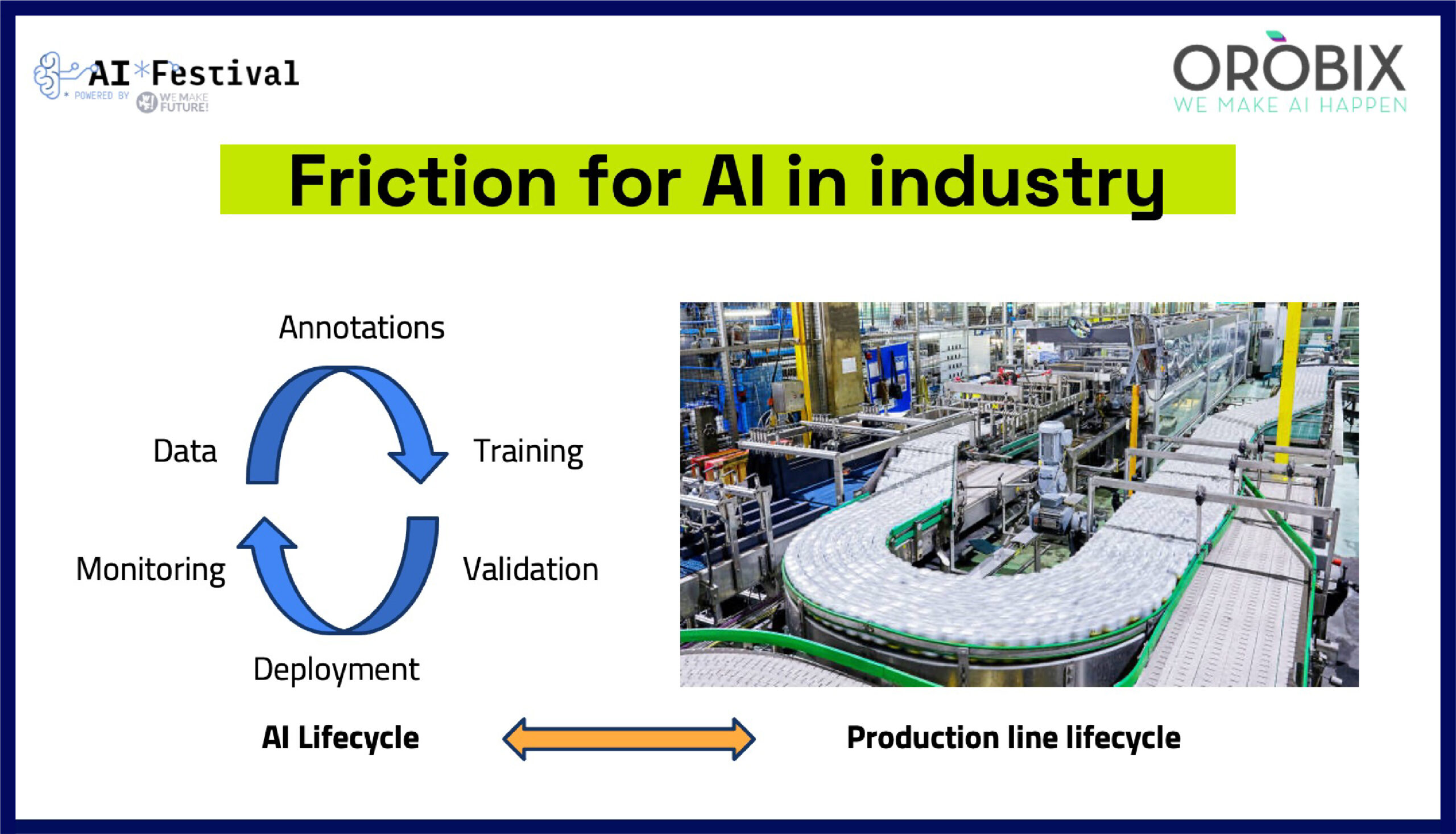
One of the key concepts Luca discussed was friction: the gap between AI’s long lifecycle and the fast pace of industrial processes.
On one hand, AI requires structured, often lengthy phases: data collection, annotation, training, validation, deployment, and continuous monitoring. On the other, production lines evolve rapidly: new products, updated tolerances, new quality criteria.
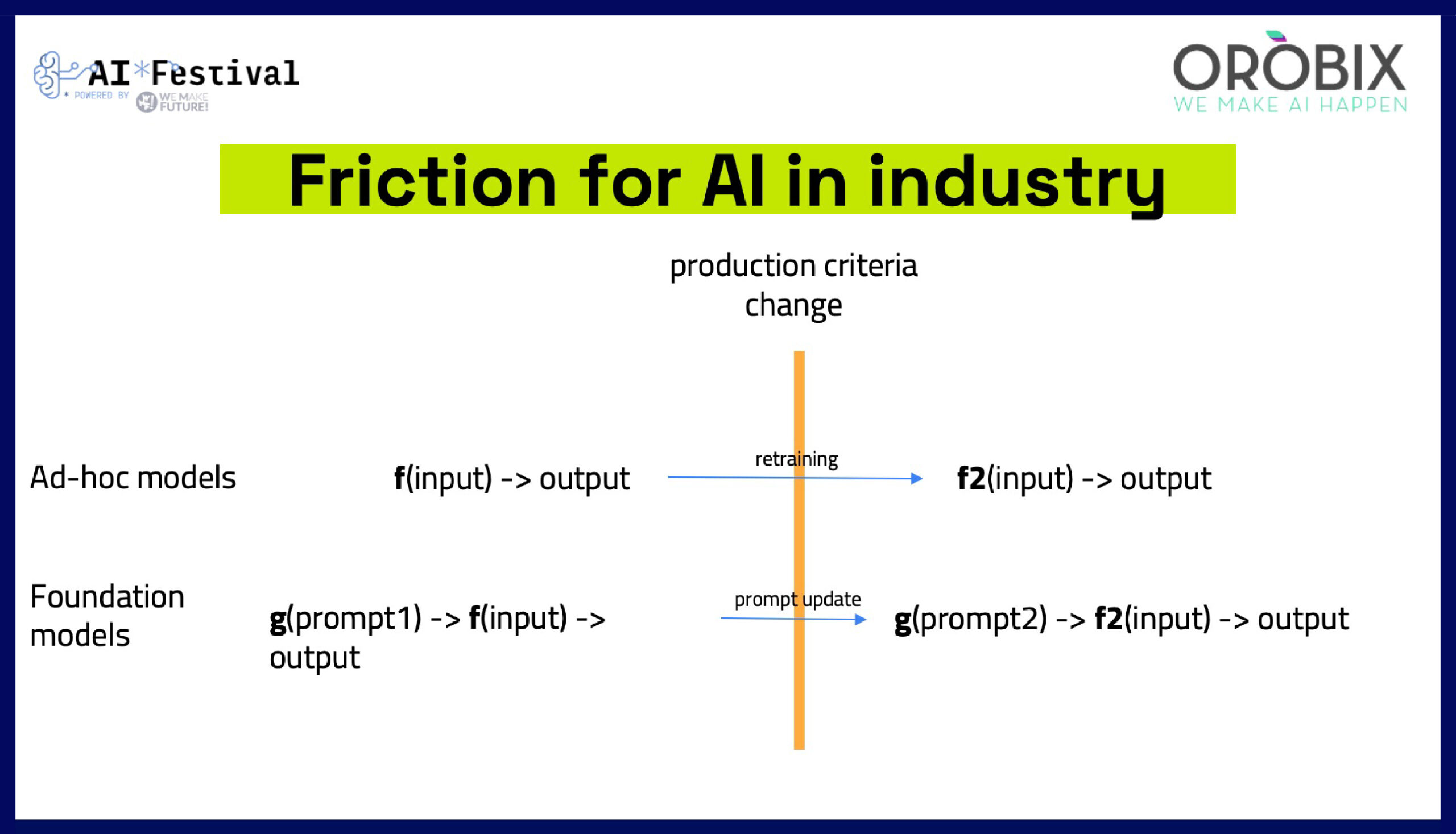
With traditional models, every significant change means retraining the model, time-consuming and costly. With foundation models and promptable systems, many changes can be handled by simply updating the prompt, without starting from scratch.
Less friction means greater agility, more trust in AI and most importantly, greater ability to generate long-term value.
More Speed, Less Friction
The most obvious effect of multimodal models is the dramatic increase in speed with which AI can be deployed in production.
In the past, even the most promising projects required long timelines before delivering tangible impact: heavy client involvement, extensive manual work, and significant investment were needed just to validate results. This slowed adoption and increased perceived risk and uncertainty.
Today, the scenario has changed. Thanks to multimodal models and AI Agents, concrete results can be achieved much faster, reducing the human effort required and accelerating decision-making. Benefits become visible sooner, adoption accelerates, and AI moves from being an experimental project to an operational tool integrated into daily processes.
Less friction also means greater sustainability: reduced reliance on manual tasks, more automation, and higher margins. This step-change finally makes scaling AI in industrial settings possible.
Vision, Language, Action: Our Idea of End-to-End Industrial AI
During the talk, Luca shared Oròbix’s vision of an end-to-end industrial AI, combining three main functions:
Vision 👉 Detect
The AI observes the physical world through images and video from industrial cameras, detecting defects, anomalies, and quality issues in real-time on the line.
Language 👉 Understand
The system understands the technical context—manuals, drawings, reports, operational procedures. It interprets defects and suggests potential causes and corrective actions, backed by company documentation.
Reasoning 👉 Act
Finally, the AI can reason and act: opening maintenance or quality tickets, suggesting operational adjustments, sending alerts, or requesting a line stop.
These three levels form the foundation for developing even more autonomous and integrated systems, capable of operating directly on the factory floor and interacting with all industrial devices and systems.
Industrial AI Agents: The Next Step
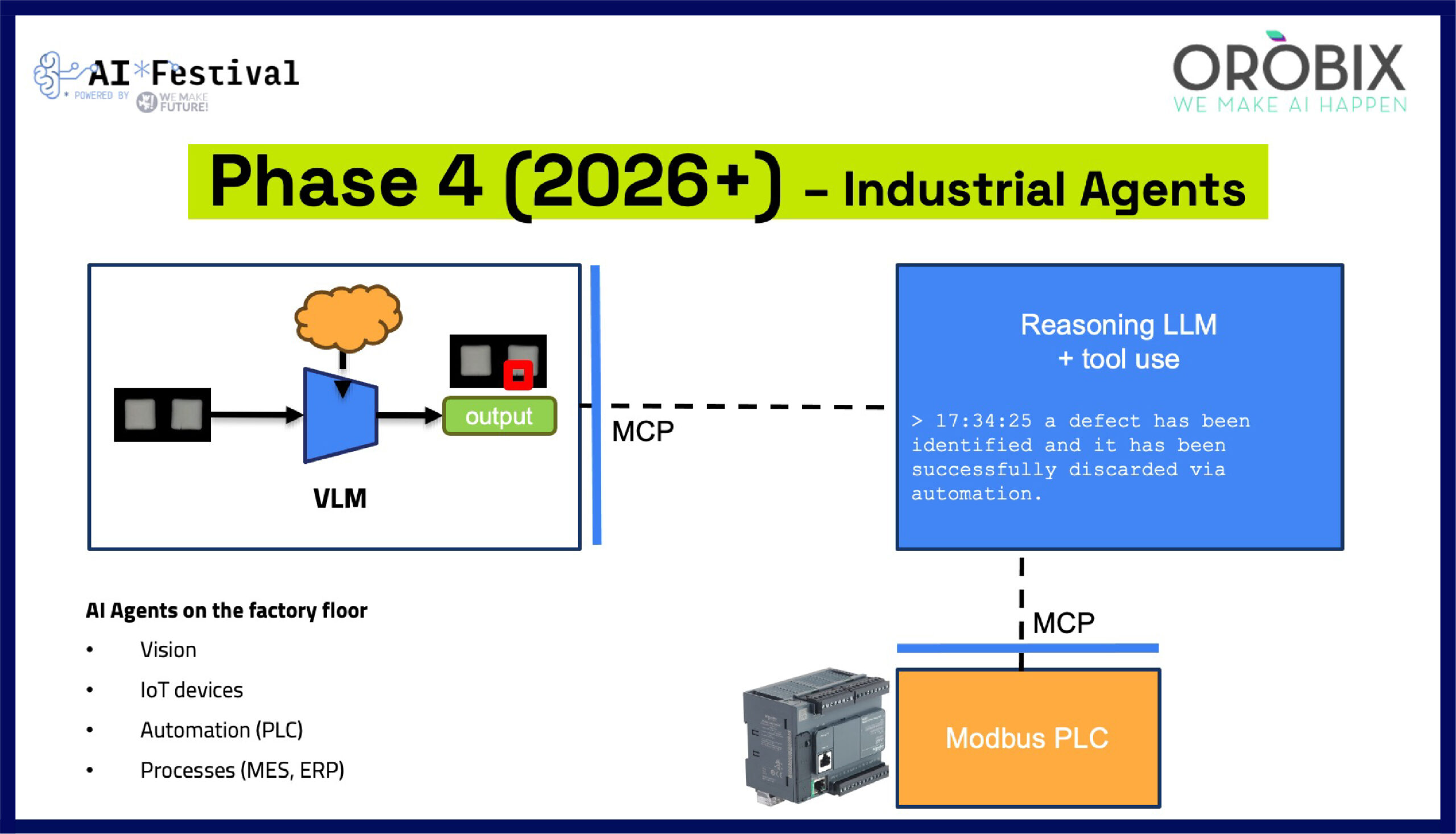
The next challenge lies with these advanced systems: intelligent agents able to operate on the factory floor, integrating with computer vision, IoT devices, automation systems, and MES/ERP platforms.
Adoption takes time, trust, and close collaboration between technology developers and those working daily on industrial processes.
If you want to explore how to bring multimodal AI and AI agents into your production environment, let’s talk! Write to us at 📩 info@orobix.com
The future of industrial AI is built together.
