From yield prediction to quality control
THE Ò-BLOG
AI for Agriculture 4.0
October 29, 2025
Reading time: 3 minutes
The agricultural sector has undergone a remarkable transformation over the past decades. From manual labor, through the introduction of advanced agronomic practices, chemical inputs, and increasingly efficient machinery, to the rise of Precision Agriculture in the 1990s, a revolution that brought GPS, mapping tools, and sensors into the field to enable targeted interventions based on the actual characteristics of soil and crops.
Today, we speak of Agriculture 4.0, the natural evolution of precision farming, driven by the integration and analysis of data collected from field sensors, on-board cameras, drones, and other digital sources.
This approach not only supports farmers’ daily decisions but also extends value creation across the entire supply chain, boosting profitability and promoting environmental, economic, and social sustainability.
Why AI works well in agriculture
The integration of Artificial Intelligence represents the next logical step in the evolution of Agriculture 4.0, enabling the transition from mere data collection to automated and predictive insight generation. Through computer vision, AI can analyze images captured at various stages, in the field, during crop delivery, or along the processing line, to monitor product quality, predict yields, and detect defects or contaminants.
Unlike traditional rule-based systems with fixed thresholds, AI adapts to the intrinsic variability of natural products. Every fruit, leaf, and crop has its own characteristics — size, color, shape, and health conditions that change constantly. Deep learning models don’t just apply predefined rules: they learn to recognize patterns, anomalies, and variations, even in complex and changing environments. This makes AI an ideal tool for field quality monitoring, disease detection, and contaminant inspection.
Use cases: AI across the agricultural supply chain
To bring AI into agriculture, you have to get your hands dirty — quite literally. That’s exactly what we’ve done in collaboration with our clients and partners, who have trusted our expertise and technology.
Our AI solutions support the entire value chain, from field to processing line, enhancing quality control, production planning, and traceability.
Here are a few real-world examples developed in partnership with growers and cooperatives:
🚜 In the field – Yield estimation and quality monitoring (apples and grapes)
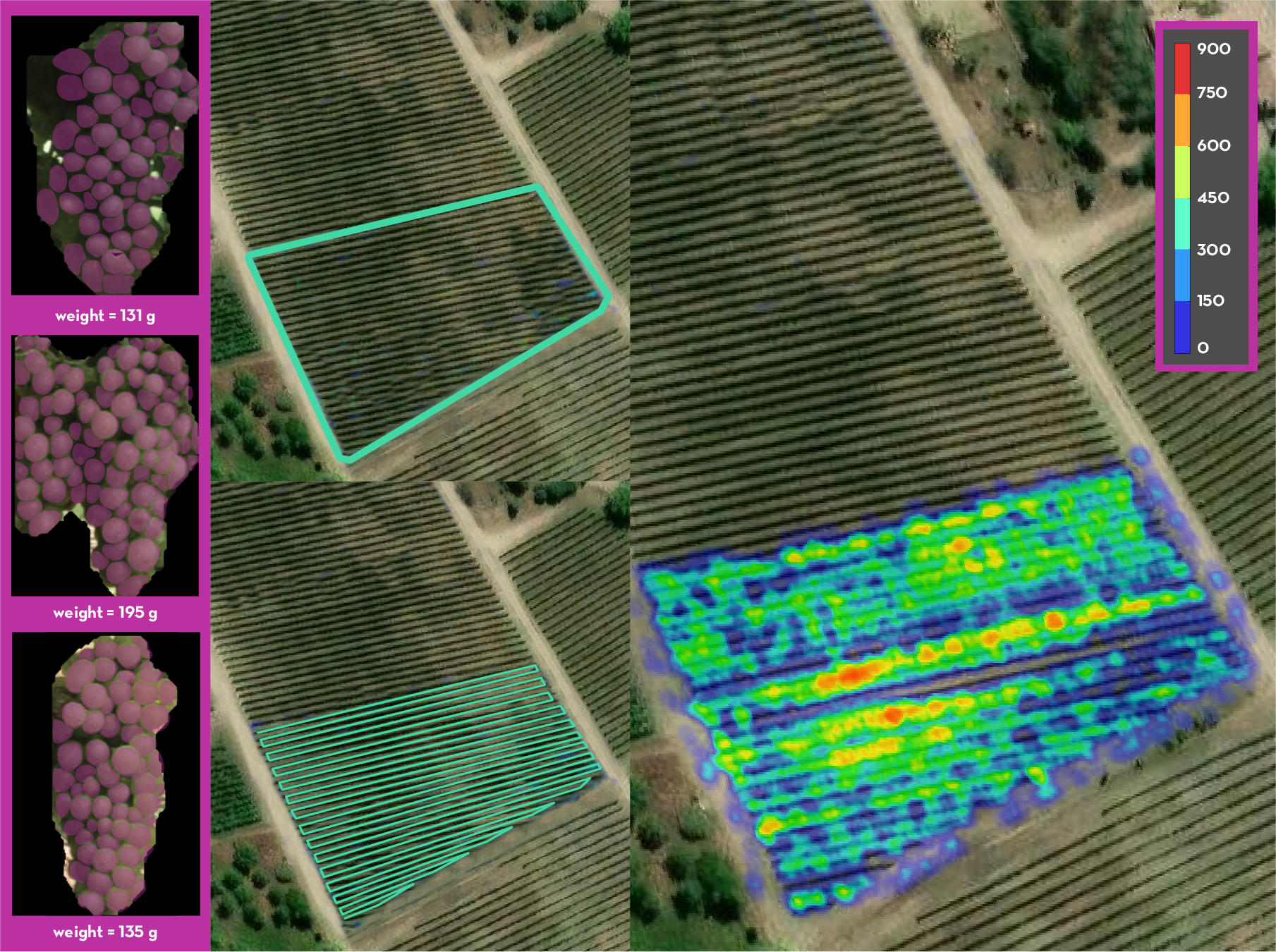
In fruit and wine production, estimating yield and quality directly in the field is essential for planning and optimizing resources and costs. We’ve developed a system that processes geo-referenced images captured by agricultural machinery during normal operations. Our AI models:
- detect fruits and estimate their ripeness level;
- predict orchard or vineyard yield;
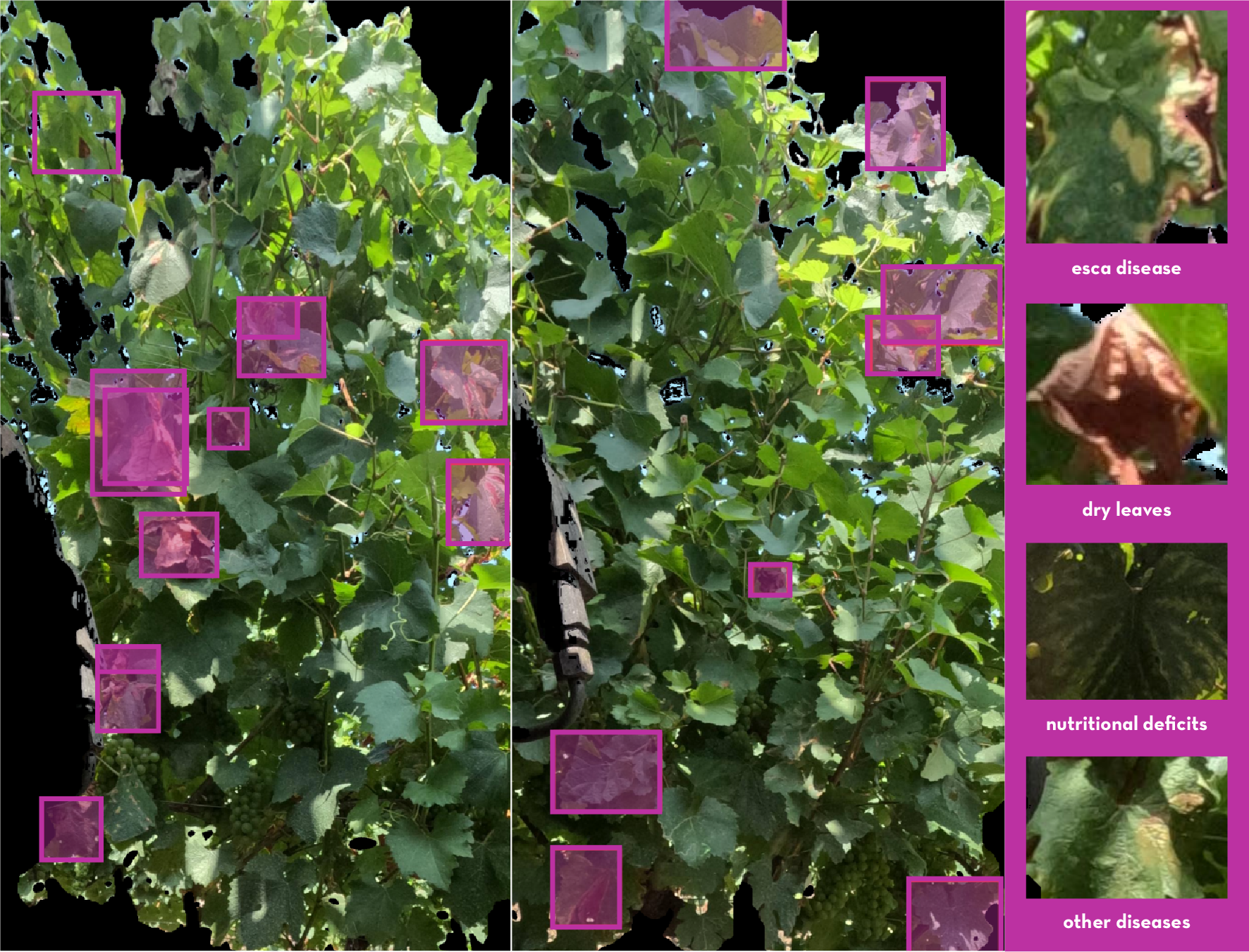
- identify defects or signs of leaf stress;
- generate yield and quality maps to guide targeted interventions and improve field management.
🍇 At delivery – Automated quality control (apples and grapes)
In cooperatives and collection centers, raw material quality assessment is a critical step. Traditionally, it’s performed through manual sampling, time-consuming and often subjective.
Our systems capture images of incoming crates, and AI models automatically estimate the overall quality of the delivered grapes or apples. The system provides an aggregated, objective, and representative measure of each batch, ensuring a non-invasive, consistent evaluation. It can be seamlessly integrated into winery or plant management software.
🍏 On the line – Contaminant detection (apples)
During industrial processing, quality control is crucial to ensure product safety and compliance. We’ve developed an AI-based contaminant detection system capable of identifying foreign objects in real time before apple pressing. The solution combines a dedicated optical setup (camera, lighting, industrial PC) with two AI models — one for detecting apples, leaves, and defects, and another for isolating foreign bodies — plus an automated mechanism that stops the line and alerts operators when an anomaly is detected. Thanks to its intelligent segmentation architecture, the system remains effective even without a predefined catalog of contaminants and can be trained with synthetic data, reducing development time and cost.

From field challenges to AI-driven solutions
It may sound straightforward, but deploying AI in agriculture means dealing with a highly variable and non-standard environment, even acquiring quality images can be a major challenge.
That’s why we developed QUALYfruit on-the-go kit,, a ready-to-use system designed to simplify image collection directly during standard field operations.
Because without high-quality images, no model can generate real value.
Once data are collected, our AI pipelines process the images to isolate what truly matters — estimating depth, segmenting trunks, leaves, and clusters even in complex lighting conditions, and delivering reliable and consistent results over time. The final step is turning data into actionable insights.
Our QUALYfruit platform manages the entire flow, from field to cloud, analyzing, aggregating, and translating results into geo-referenced maps and indicators. Today, it’s used by leading fruit and wine producers to detect fruit damage and defects, identify early signs of leaf diseases, estimate yields, and optimize production planning.

Our approach: AI at the service of growers
Whether it’s apples, grapes, or vegetables, the principle remains the same: using Artificial Intelligence and computer vision to turn images and data into operational intelligence. Faster, more targeted decisions. Less waste. Greater quality and sustainability across the entire value chain.
With our solutions, quality control becomes more precise, reliable, and integrated, giving agriculture a new form of value, the ability to make truly data-driven decisions. Our AI doesn’t replace the farmer’s expertise, it enhances it, strengthening the connection between technology and the land.
👉 If your organization wants to explore how AI can make a difference in agriculture, contact us at info@orobix.com ✉️ We’re ready to build your next project together.
